

In an era where data drives decisions, artificial intelligence (AI) rapidly transforms how colleges and universities prepare for accreditation and navigate complex state approval processes. Organizations like AccreditationXpert.com have helped institutions nationwide embrace digital transformation—not only in the classroom but also across compliance and regulatory operations. With over two decades of experience guiding higher education and vocational schools like NIU College through national, regional, and programmatic accreditation, we understand that regulatory readiness is no longer a manual checklist; it’s a strategic, tech-enabled initiative.
AI’s Role in Accreditation: A Shift Toward Intelligent Compliance
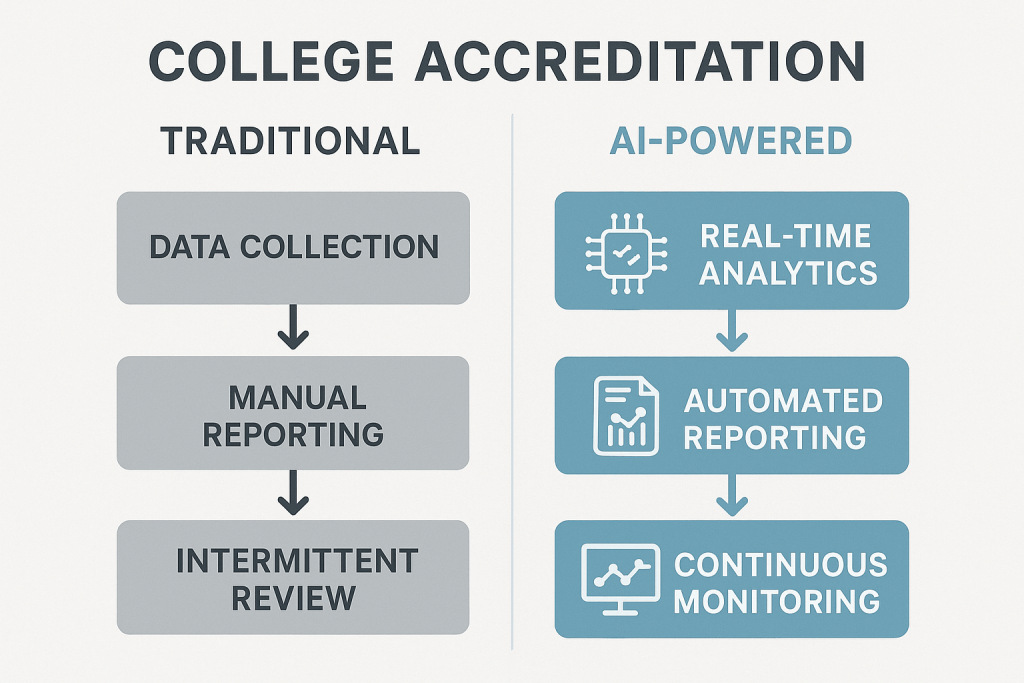
Accrediting bodies and state regulators demand greater transparency, real-time reporting, and demonstrable outcomes—driven by a broader shift toward data-driven decision-making in higher education. Institutions that continue to rely on outdated manual processes—spreadsheets, disjointed databases, or legacy student information systems—are increasingly at a disadvantage. The modern regulatory environment does not merely request compliance; it requires proof of compliance, often in real-time. This evolving landscape places enormous pressure on institutional leaders, accreditation liaisons, and compliance officers to not only maintain accurate records but also synthesize them into actionable insights that align with external standards. This is where artificial intelligence (AI) enters the picture—not as a replacement for human expertise, but as a transformative accelerator that enhances institutional effectiveness and responsiveness.
Artificial intelligence is rapidly becoming an essential partner in the accreditation journey. From intelligent dashboards that display key metrics to automated systems compiling comprehensive evidence portfolios, AI enables proactive compliance with accrediting standards in previously unimaginable ways. For example, AI-powered platforms can aggregate and analyze student learning data in real time, drawing from learning management systems (LMS), assessment software, and institutional research tools. This consolidation allows for immediate identification of patterns, such as declining retention rates or inconsistent performance across key competencies—issues that might otherwise go unnoticed until an annual report or site visit triggers an urgent response.
One of the most powerful contributions of AI in this space is its ability to identify gaps in outcomes assessment well before an accreditor’s visit. Through predictive analytics and pattern recognition, AI can detect where student learning outcomes are not being met, where faculty engagement may be low, or where course-level data fails to align effectively with programmatic goals. Rather than waiting for auditors or site evaluators to raise red flags, institutions can proactively intervene and course-correct—meeting both the letter and the spirit of continuous improvement. In this way, AI doesn’t just help institutions remain compliant; it enhances their strategic capacity to respond dynamically to challenges and improve quality at every level.
Moreover, AI streamlines one of the most time-consuming aspects of accreditation: documentation. Traditionally, creating the narrative and providing the corresponding evidence for accreditation reports has involved months of manual labor—collecting faculty credentials, catalog descriptions, meeting minutes, assessment rubrics, and student evaluations. With AI-enhanced systems, institutions can automatically tag and organize documentation according to the standards of a specific accreditor, saving hundreds of hours per review cycle. This automation supports regulatory readiness not just for one accreditor but for multiple reviews simultaneously, covering various types of college accreditation such as regional, national, and programmatic processes.
Another critical advantage of AI is its ability to align institutional performance with evolving state and federal benchmarks. Regulations change frequently, and institutions often struggle to keep up with new reporting frameworks, compliance mandates, or funding requirements. AI solutions can integrate with government databases and update institutions in real time on changes to licensure pass rate thresholds, gainful employment metrics, or student achievement benchmarks. In doing so, schools can adapt policies, reconfigure reporting workflows, or leverage curriculum development services—all before falling out of compliance.
Perhaps most importantly, these innovations reduce administrative burden while enhancing institutional intelligence. Instead of scrambling to find data during accreditation season, academic affairs teams can focus on analyzing what the data actually means. This real-time visibility and foresight transform compliance from a reactive process to a strategic function—where accreditation becomes a living system of accountability, not a one-time hurdle to clear every few years.
Ultimately, AI is not a luxury—it is a necessity for institutions that wish to remain competitive, agile, and reputable in the eyes of accreditors, regulators, and the students they serve. By embracing intelligent compliance technologies, colleges and universities are better positioned not only to meet existing standards but also to anticipate future expectations, ensuring both short-term accreditation success and long-term institutional excellence.
Intelligent Dashboards: Real-Time Insights for Leadership
Today’s AI platforms allow academic leaders to visualize institutional performance through interactive dashboards. These advanced tools offer real-time views into critical data points such as:
- Completion and retention trends
- Faculty credential tracking
- Program-level learning outcome metrics
- Compliance gaps in financial aid, admissions, or academic integrity
These AI-powered dashboards are able to consolidate disparate data sources—student information systems, learning management platforms, and financial databases—into one intuitive interface. This integration eliminates data silos and offers leadership teams a comprehensive, real-time understanding of institutional operations and academic health.
More importantly, this level of visibility directly supports continuous quality improvement, which is the cornerstone of modern accreditation and state authorization standards. By providing dynamic visualizations and predictive analytics, intelligent dashboards enable institutions to identify and act on potential issues long before they escalate. For instance, a dip in retention in a specific program or demographic group can be flagged immediately, prompting timely intervention and strategic decision-making.
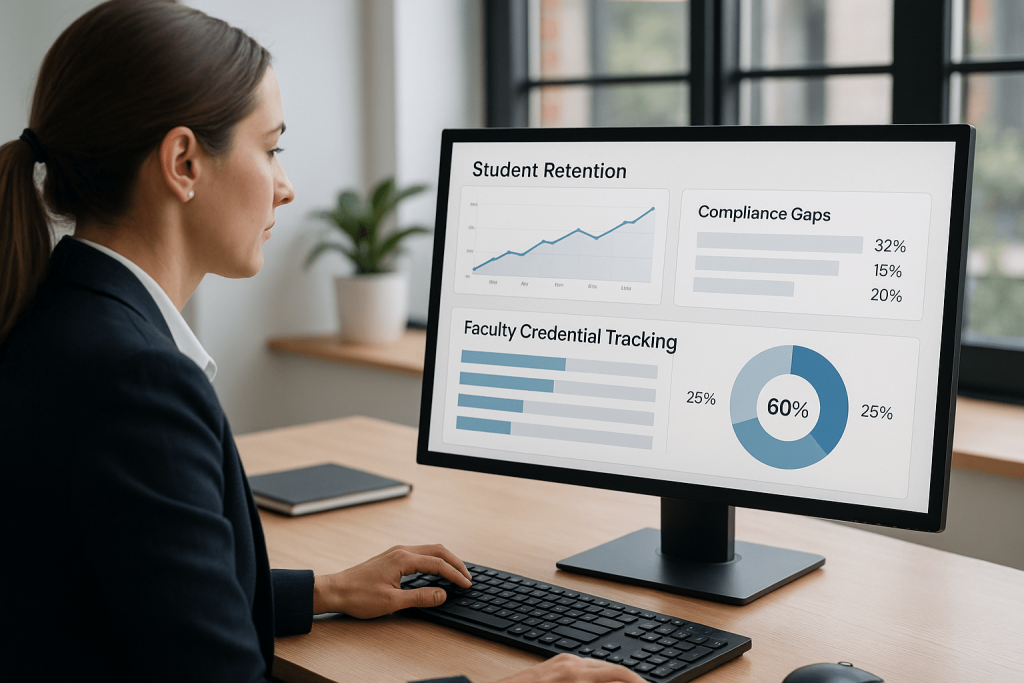
From a compliance perspective, these dashboards also play a crucial role in ensuring proactive compliance. Rather than scrambling to assemble last-minute reports for accreditors or regulatory agencies, institutions can maintain regulatory readiness through always-on tracking. This means schools can produce accurate, auditor-ready documentation anytime—streamlining site visits, mid-cycle reviews, and annual reporting.
For leadership teams, this represents a game-changer. Presidents, provosts, and accreditation liaisons no longer need to depend on retrospective data or anecdotal input. Instead, they can make decisions based on real-time, validated metrics that directly align with accreditation benchmarks and state oversight requirements. This proactive model enhances institutional agility and positions colleges and universities as leaders in transparency, accountability, and data-informed governance.
In short, intelligent dashboards are more than just a tech upgrade—they are essential tools for aligning institutional strategy with regulatory demands and fostering a culture of evidence-based excellence.
Streamlining State Approval with AI
As higher education institutions navigate an increasingly complex regulatory landscape, state licensure agencies are evolving their expectations. No longer satisfied with static, once-a-year submissions, many states now require real-time digital documentation, student achievement metrics, and proof of ongoing institutional effectiveness. For new institutions seeking authorization or for established colleges maintaining their state licensure, this shift presents a significant challenge—especially for schools operating across multiple jurisdictions. Fortunately, artificial intelligence (AI) is transforming how schools approach state approval processes, making them faster, more efficient, and more reliable.
AI tools can now generate required reports with minimal staff input, pulling data automatically from student information systems (SIS), learning management systems (LMS), and other integrated platforms. This reduces the need for time-intensive, manual report assembly and dramatically lowers the chance of human error. Whether it’s a detailed report on student graduation and retention rates or program-level assessments required for a new program proposal, institutions can produce compliance-ready documentation with a few clicks—saving valuable staff hours and resources.
In addition, AI systems are increasingly effective at tracking licensure and job placement rates for career and technical education programs. These outcome metrics are often critical for state approval and must be tracked over time to demonstrate program success. AI monitors these data points and can alert institutional leaders to any downward trends, ensuring early intervention and supporting a more strategic, data-informed approach to program evaluation and improvement. This is key to demonstrating continuous quality improvement, a central focus for both state regulators and accreditors.
Another advantage of AI in the state approval process is its real-time monitoring of regulatory changes. States frequently update their approval guidelines, licensure board rules, or performance benchmarks—and institutions that miss these changes risk falling out of compliance. AI tools integrated with state education databases or legal monitoring services can issue alerts whenever a policy is updated, helping ensure proactive compliance. Rather than reacting to an outdated checklist, institutions stay ahead of the curve—ready to adjust processes and documentation as needed.
This kind of automation empowers institutional teams to focus on strategy rather than paperwork. Academic leaders and compliance officers can shift their efforts toward improving student outcomes, refining academic programs, and expanding into new markets—while rest assured that the institution’s compliance infrastructure is robust and current. AI accelerates the approval process for new schools by ensuring that all required evidence is properly formatted, organized, and submitted without delay. For established institutions, AI supports regulatory readiness year-round, minimizing the risk of interruptions to operations due to compliance gaps.
In short, integrating AI into state approval workflows is more than just a convenience—it’s a strategic advantage. Institutions that adopt these technologies achieve faster and smoother approvals and build the internal systems needed to thrive in a data-driven regulatory environment. As oversight grows more demanding, those prepared with smart automation will stand apart as efficiency, transparency, and trustworthiness models.

Why Partnering with Accreditation Experts Matters
While AI tools offer transformative potential in reshaping how institutions approach compliance and reporting, the successful adoption of these technologies demands more than just software—it requires a strategic implementation framework rooted in experience, nuance, and an in-depth understanding of accreditation culture. That’s where AccreditationXpert.com delivers unmatched value. We don’t just offer templates or generic advice—we provide end-to-end consulting solutions that are tailored, tactical, and designed to ensure both regulatory readiness and long-term institutional excellence.
Our team of experts brings decades of combined experience across national, regional, and programmatic accreditation landscapes. We’ve helped higher education institutions, vocational schools, and distance learning providers navigate the full life cycle of accreditation and state authorization—now integrating advanced AI and automation tools into the process. We begin by helping institutions select the right AI platforms that offer modern analytics and map seamlessly to accreditor expectations. Every accrediting agency has its own framework, standards, and documentation preferences—our consultants ensure your tech stack is efficient and compliance-aligned.
We also train leadership teams, compliance officers, and academic staff to effectively integrate AI tools into existing accreditation workflows. From real-time dashboards to automated report generation, we help demystify the tools and create a sustainable operational model that enhances visibility and accountability. More than just technical onboarding, we align this training with best practices for accreditation readiness—ensuring your staff gains confidence, not confusion.
In addition, our experts conduct detailed compliance audits to identify gaps in documentation, assessment, and institutional effectiveness planning. We then design tailored, future-ready solutions that support both proactive compliance and continuous quality improvement. Whether you’re facing an initial site visit, a mid-cycle report, or a reaffirmation of accreditation, we prepare your institution to meet and exceed expectations with clarity, organization, and data-driven precision.
At AccreditationXpert.com, we bridge the gap between innovation and regulation. As AI and automation reshape the higher education landscape, institutions need partners who understand both the promise of new technology and the realities of accreditation compliance. Our mission is to ensure that your institution meets baseline requirements and emerges as a leader in transparency, efficiency, and educational excellence.
Final Thoughts: From Compliance to Competitive Advantage
AI isn’t just about efficiency; it’s about empowering institutions to be more responsive, transparent, and prepared. In a competitive landscape, demonstrating regulatory readiness, maintaining proactive compliance, and fostering a culture of continuous quality improvement are more than goals—they’re strategic differentiators.
Companies like AccreditationXpert.com can help you future-proof the accreditation journey by integrating smart tools with seasoned expertise. At the end of the day, AI is the future and will be needed to move forward. In doing so, your institution will be for the better and will thrive to levels previously only available to organizations with hundreds of employees and millions of dollars. Now you can be at the same playing level!
